The Lever Lens · Issue 02 · Insight Lever
The Insight Lever: Why Angela Shori starts with fit before volume
When a business says it needs more leads, the problem may not be volume at all. Angela Shori starts further upstream: diagnose who is genuinely relevant, what problem the business is actually solving and where limited resources have the best chance of producing growth.

When a business says it needs more leads, the problem may not be volume at all.
Angela Shori starts further upstream: diagnose who is genuinely relevant, what problem the business is actually solving and where limited resources have the best chance of producing growth.
Get The Lever Lens
One credible female founder. One real application of AI.
The business lever it strengthens—and a practical way to apply it.
Delivered monthly · unsubscribe anytime
The problem beneath “we need more leads”
There is a familiar response when growth slows.
We need more leads.
More outreach.
More campaigns.
More meetings.
More activity.
But in my conversation with Angela Shori, founder of SHYFT Insights, she kept returning to a different diagnosis:
“It’s always they say they need more leads and it’s almost always that the ideal customer profile is not dialled in enough.”
That is why I see Insight as the primary Business Lever in Angela’s story.
The constraint is not necessarily the business’s ability to do more.
It is whether the business is clear enough about where doing more is actually worth it.
And if the diagnosis is wrong, increasing activity can simply scale the mistake.
Angela sees go-to-market as something bigger than Marketing or Sales.
It begins with what the company is building, who it is for and what problem it solves. Then Product, Marketing, Sales and Customer Success all have to operate around that same understanding.
Each function can appear to be doing its job while the whole system is still misaligned.
Sales can close a customer who was never the right fit.
The consequence may not appear immediately.
Customer Success has to work harder. The product may not be used as intended. The customer may not achieve the expected result. Renewal becomes harder. And the business then has to replace customers it should have been able to retain.
So Angela does not define an ideal customer simply by industry, company size or job title.
She keeps asking why.
Who has the problem now?
Who can the business genuinely serve now?
Who is willing and able to buy now?
And where is the company most relevant now?
That leads to one of the most useful ideas from our conversation: Total Relevant Market.
TAM asks how large the theoretical opportunity might be.
TRM asks something much more practical:
How much of that market is genuinely relevant to the business you are capable of serving today?
Fit before volume
A business may be able to help many different kinds of customers.
That does not mean it should pursue all of them at once.
A growing company has limited money, people and time.
The useful question is not simply:
Where can we grow?
It is:
Where can we grow the most?
That requires choosing.
And choosing means giving up some theoretical opportunity so the business can concentrate its resources where it fits strongest.
That is not smaller ambition.
It is directed ambition.
And this is where Growth becomes a downstream effect of Insight.
The growth activity has not disappeared.
It has been pointed somewhere more useful.
Your best customers are already giving you evidence
One of Angela’s most practical suggestions is to start with the customers the business already has.
But not only the people Sales managed to close.
Look across the customer journey.
Who wanted to buy?
Who actually uses the product as intended?
Who gets the value you expected them to get?
Who renews?
Sales can tell you who wants to buy.
Customer Success can help show who actually succeeds.
Product has another part of the picture.
Angela’s point is that defining the ideal customer is not a Marketing exercise.
It is a business decision.
And that exposes an important operating problem.
A company can optimise each function separately while never asking whether those functions are learning from the same customer evidence.
Better Insight is not valuable because it produces a better-looking ideal customer document.
It matters because it changes where the business places its bets.
Proximity creates blind spots
There was another line from Angela that stayed with me:
“It’s really hard to see things from the inside sometimes.”
When you have lived inside a business for years, you understand how things are supposed to work.
That knowledge is valuable.
It can also make it harder to see where reality has moved away from the version in your head.
Angela went on to explain that people inside an organisation can push for change, but without support from the top those changes often remain temporary or isolated.
That connects to another of her arguments:
Who owns go-to-market?
Not Marketing alone.
Not Sales.
Not the CRO.
Ultimately, Angela argues that the CEO owns GTM, because only the person with authority across the whole system can create the alignment required to change it.
Insight without the ability to act on it can remain an observation.
The organisation can correctly identify the wrong ideal customer, weak positioning or a retention problem and still fail to change anything meaningful if every function continues to optimise its own piece.
Seeing differently has to lead to deciding differently.
Where AI enters the picture
Angela’s use of AI is interesting because AI is not the source of the strategy.
Her experience creates the criteria.
AI helps her apply them.
Angela works heavily through Claude.
Her CRM lives in Notion, but she described interacting with much of it through Claude instead of constantly going into Notion itself.
Claude can surface people she needs to follow up with, meetings and reminders. It can help frame the day using information from her calendar and email.
But the example that connects most directly to the Insight Lever is her ideal customer scorer.
Angela identified something she was repeatedly doing by hand: looking at a company and deciding whether it really matched the customer she wanted to pursue.
So she turned those criteria into a process Claude could help apply.
Prospects broadly come back as:
- Green: fits the criteria.
- Yellow: needs another look.
- Red: not the right fit.
Before that, Angela describes falling into a familiar trap:
They’re not my ideal customer, but I could help them.
The scorer creates some discipline between:
I could help them
and
I should pursue them.
That distinction matters commercially.
Angela still created the criteria.
She still reviews the result.
She refined the system when it classified companies incorrectly.
And she still decides whether a prospect deserves her attention.
AI helps make the judgement more repeatable.
It does not create the judgement for her.
AI can reduce friction. It cannot supply the judgement.
That boundary appears throughout Angela’s use of AI.
She uses it heavily for mundane and repeatable work.
She is much less willing to delegate the thinking that makes the work good.
Her description of the relationship is wonderfully practical:
“I wanted an admin, but I got an intern instead.”
For creative work, Angela may give AI information and ask for a first version, but the ideas begin with her and she often rewrites what comes back.
For discovery calls, AI can help gather information and develop a working hypothesis.
But the preparation is not there to decide the answer before the conversation begins.
It is there to help her enter with better questions.
The same applies when transcripts and notes are used to create a first draft of an engagement scope.
AI can get the information together.
It can help remove the blank page.
The first answer may still be wrong.
And Angela experienced the risk directly when AI produced confidently incorrect information outside an area where she had the same level of subject expertise — including a floor plan with no doors.
The lesson is not that AI should be avoided.
It is that domain expertise changes your ability to challenge what it gives you.
AI can organise evidence.
AI can apply established criteria.
AI can reduce friction.
The person who understands the business still has to decide what matters.
The Five Business Levers
The Five Business Levers
AI applied is the lane. The Business Levers are the lens used to understand where and how to apply it.
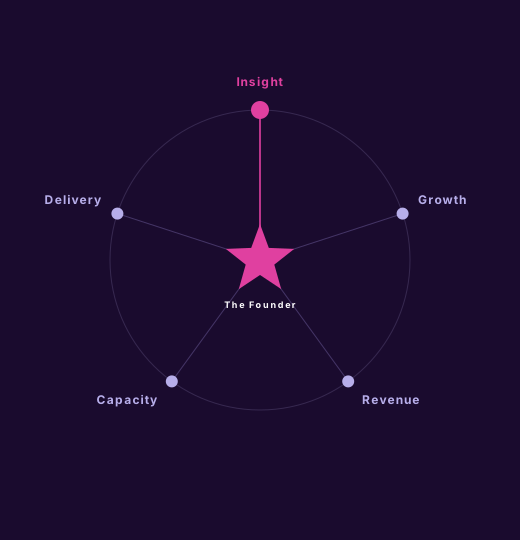
| Business lever | What changed inside Angela's business |
|---|---|
| Insight | Better diagnosis clarifies who is genuinely relevant, brings customer evidence together and helps Angela apply her ideal-customer criteria more consistently. |
| Growth | Better fit directs limited growth effort towards the customers and markets where the business has the strongest relevance. |
| Revenue | Better-fit acquisition creates stronger conditions for conversion and retention while reducing the cost of pursuing or replacing wrong-fit customers. |
| Capacity | Claude surfaces follow-ups, prepares context and applies prospect criteria so Angela can spend more attention on judgement and decisions. |
| Delivery | Better diagnosis gives the business a clearer customer to serve. The effect is indirect and begins upstream in the decisions that shape delivery. |
My Lever Lens takeaway
The more I thought about Angela’s conversation, the less I saw it as a story about lead generation.
It is a story about diagnosis.
Businesses often respond to a disappointing result by increasing the activity associated with that result.
Not enough pipeline?
Send more outreach.
Not enough sales?
Book more meetings.
Growth slowing?
Expand the market.
But volume cannot correct a bad diagnosis.
It can make the problem more expensive.
Angela’s practice starts one step earlier.
What do we actually know?
Who is genuinely succeeding with us?
Who has the problem now?
Where are we relevant now?
What assumption are we treating as fact?
And what do we still need to learn before acting?
That is the Insight Lever.
AI becomes valuable after enough human thinking has happened to establish what deserves to be applied repeatedly.
It can retain context, organise information, apply criteria and remove friction.
But the commercial judgement has to come first.
Better insight does not replace growth activity. It tells the business where that activity has the best chance of mattering.
Watch. Take. Ship.
Watch
Watch Angela’s full founder conversation and see how she thinks about customer fit, Total Relevant Market, organisational alignment and the way she uses Claude inside her working day.
Watch Episode 02 with Angela Shori →
Take
Diagnose before you amplify.
Before increasing activity, establish whether that activity is aimed at the right customer, the right problem and the right constraint.
Ship
Angela’s approach to discovery conversations informed the Conversation Prep Toolkit.
It helps you clarify what you know, separate evidence from assumption, identify what you still need to learn and walk into an important conversation with a point of view — without walking in with the answer already decided.
You can also practise the conversation through role-play and receive feedback before having it for real.
Get The Lever Lens
One credible female founder. One real application of AI.
The business lever it strengthens—and a practical way to apply it.
Delivered monthly · unsubscribe anytime
One question to take back to your business
Where in your business are you currently increasing activity before you have properly diagnosed the problem?
The Lever Lens is where Michelle Jones-Walker examines each AI Power Women conversation through five commercial levers: Insight, Growth, Revenue, Capacity and Delivery. Business acumen provides the lens; applied AI is the lane.